 CN
CN

ABOUT ZISU

ABOUT ZISU

 INTRODUCING ZISU
History
Zhejiang International Studies University (ZISU) is an institution of higher learning in Zhejiang province that specializes in the studies of foreign languages and literatures, regional and country studies, and a range of other supporting academic disciplines. It was established formerly as a training college of education in 1955, and engaged in regular undergraduate teaching in 1994. In 2010, with the approval of the State Ministry of Education, it was restructured as a full-time college offering undergraduate programs. In 2018, the school received accreditation for undergraduate education from the Ministry, marking the beginning of its new development. In 2024, it obtained its status as a master’s degree conferring entity offering graduate programs. The school’s motto is “Virtue, Perseverance, Erudition, Practicality”.
Education Programs
ZISU currently has 13 teaching schools offering 36 undergraduate programs, among which 16 are foreign language programs. The languages taught are English, Japanese, Spanish, French, Arabic, Italian, Portuguese, Russian, Korean, German, Czech, Turkish, Polish, Vietnamese, Indonesian and Thai. Seven undergraduate programs (English, Primary Education, Arabic, Translation, Tourism Management, Business English, and Russian) are accredited as national first-class programs, and 7 others (TCSOL, International Business, Chinese Language and Literature, International Economics and Trade, Korean, Spanish, Convention & Exhibition Economy and Management) as provincial first-class programs. Six academic disciplines (Foreign Languages and Literatures, Regional and Country Studies, Chinese Language and Literature, Pedagogy, Business Administration and Applied Economics) are rated as first-class of the province, offering master’s programs in Regional and Country Studies, and professional master’s programs in Education and Translation.
-
13
Schools
-
3
Master's Degree Programs
-
36
Undergraduate Programs
-
10000
Student Population
-
160
Programs
Students
Recruiting students from 17 provinces and autonomous regions in China, ZISU now has a student population of over 10,000. It aims to cultivate high-end application-oriented talents with a sense of national identity and a global vision, proficient in foreign languages, strong in digital intelligence capabilities, and capable of fulfilling the mission of cultural exchange and mutual learning among civilizations, and communicating Chinese and Zhejiang culture worldwide. As a pilot school for fostering applied talents on the undergraduate level, a leading school in classroom teaching innovation, a demonstration center for faculty teaching development, a practice base of the China Center for International People-to-People Exchange under the Ministry of Education for cultivating high-level international talents, and a key modern industrial college under construction by the province, ZISU has created many innovative programs, such as the “Foreign Language Plus”, the “Dual Campuses” and the “Innovative Experimental Classes”. All this has enabled the school to fulfil its unique mission of cultivating international talents in languages and cultures, business, tourism and education. One of the cases in point is the international volunteer services offered by students and faculty, ZISU’s hallmark in promoting the internationalization of Zhejiang. The school has provided over 21,000 volunteers for major events such as the Hangzhou Asian Games (and Paralympics), the G20 Hangzhou Summit, the World Internet Conference, the Liangzhu Forum and the Global Mayors Dialogue, rendering services for guests from over 150 countries and regions and earning more than 600 honors. Also, students from ZISU have won numerous awards in high-level academic competitions, such as the gold award in National College Students’ Foreign Language Proficiency Competition “Understanding Contemporary China”, the National Grand Prize in the “FLTRP Cup” English Writing Competition, and the First Prize in the “Challenge Cup” National College Student Extracurricular Academic and Technological Works Competition. The quality of its students has been recognized by the public, with a high average employment rate of undergraduates in recent years.

Faculty
ZISU has over 900 faculty and staff members, more than 40% of them holding senior professional titles, over 60% with doctoral degrees, and over 50% with research experience overseas. Over 80% of the foreign language faculty have studied abroad. Currently, the school has 16 national-level leading talents, 7 faculty members who receive special government allowances from the State Council, and 1 recipient of the “National May 1st Labor Medal”. Two teachers are elected as provincial and ministerial-level talents for their outstanding contributions, and 3 others have been selected for provincial youth talent projects. The school also has 30 participants in the provincial “151 Talent Project,” 4 Zhejiang Young Scholars in Social Sciences, and 11 members in the Provincial Higher Education Leading Talent Cultivation Program. Nine faculty members serve on the Ministry of Education’s Higher Education Teaching Steering Committee (including 2 as vice chairpersons), and 14 more are on the Provincial Higher Education Undergraduate Teaching Steering Committee (including 2 as chairpersons and 2 as vice chairpersons). In addition, ZISU has appointed over 40 senior professors, full-time distinguished professors, and part-time professors.
Research and Community Service
ZISU focuses on enhancing its capabilities in research and social service. In recent years, the number of high-level research projects, papers and awards has significantly increased. Its construction of specialized think tanks has shown remarkable results. The school has started strategic cooperation with government departments such as the Department of Commerce, the Department of Culture and Tourism, and the Foreign Affairs Office of Zhejiang province. It boasts 9 provincial and ministerial-level research institutes, including a research base under the Zhejiang Research Center for Xi Jinping Thought on Socialism with Chinese Characteristics for a New Era, the Institute for Advanced Studies on New International Relations (the Research Institute for BRICS SEZ Cooperation), Regional and Country Studies Research Center, the Collaborative Innovation Center for International Communication of Zhejiang Culture, and the Collaborative Innovation Center for Grand Canal Cultural Exchange and Mutual Learning of Civilizations, and 8 international research collaboration platforms, such as the UN Regional Centre of Expertise on Education for Sustainable Development (Hangzhou), and the International Research Platform for Industry-Education Integration of the Silk Road E-Commerce. The school has established 2 joint research institutes with the China Center for International People-to-People Exchange under the Ministry of Education, and a cross-border e-commerce research institute in cooperation with Pujiang County Government. Over the past 3 years, about 100 research outcomes of these entities have received attention and directives from central and provincial leadership. The Journal of Zhejiang International Studies University is accredited as one of the elite social science journals of higher education institutions nationwide.
ZISU serves as a demonstration trainer for the Ministry of Education’s “National Training Program”, a principal training base for the Ministry’s “Leadership Project”, a key base for teacher education in Zhejiang, and an international service outsourcing talent training base in the province. It is entrusted by the Provincial Department of Education to run the Provincial Training Center for Teachers and Administrators and the Sino-German Cooperation Project Office for Teacher Training. Since its establishment, the school has trained over 350,000 individuals. It also publishes three teaching magazines: Teaching Monthly (Middle School and Primary School Editions), and New World of Composition, along with an educational newspaper titled Children’s World.
International Exchange and Cooperation
As the Provincial Base for International People-to-People Exchange, ZISU has signed educational exchange agreements with nearly 150 universities and institutions in more than 50 countries and regions, including the University of Oxford in the UK, LMU Munich in Germany, and the University of Wisconsin in the USA. It is the initiator of the “International Community for Industry-Education Integration of Silk Road E-Commerce”, the “International Chinese Language Education Community for the Caribbean Region” and the “China-Latin America Art Alliance”. It has been selected into the “China-Arab Universities 10+10 Cooperation Program” and is a member institution of the “Global Alliance of Foreign Studies Universities”, the “China-Russia Alliance of Similar Higher Education Institutions” and the “China-Belarus Youth Innovation Forum”. To ensure that every student has access to international exchange opportunities, the school offers more than 160 long-term student exchange programs, sending over 500 students abroad for exchanges each year. Additionally, through international summer schools, exchange groups, and online courses, it provides students with high-quality international educational resources.
ZISU has established platforms for international youth exchanges and cultural exchanges, helping students engage in cross-cultural interactions and communication. It has set up the “Teaching Studio for International Students’ National Conditions Education”, with over 400 international students from more than 50 countries studying on campus long-term.
Attaching great importance to TCSOL, ZISU has established the Confucius Institutes at the National University of Equatorial Guinea, in Antigua and Barbuda, and at the Francisco Morazán National Pedagogical University in Honduras. It has also collaborated with the Federal University of Rio Grande do Norte in Brazil and the University of Colima in Mexico to launch online Chinese language courses.
Location and Facilities
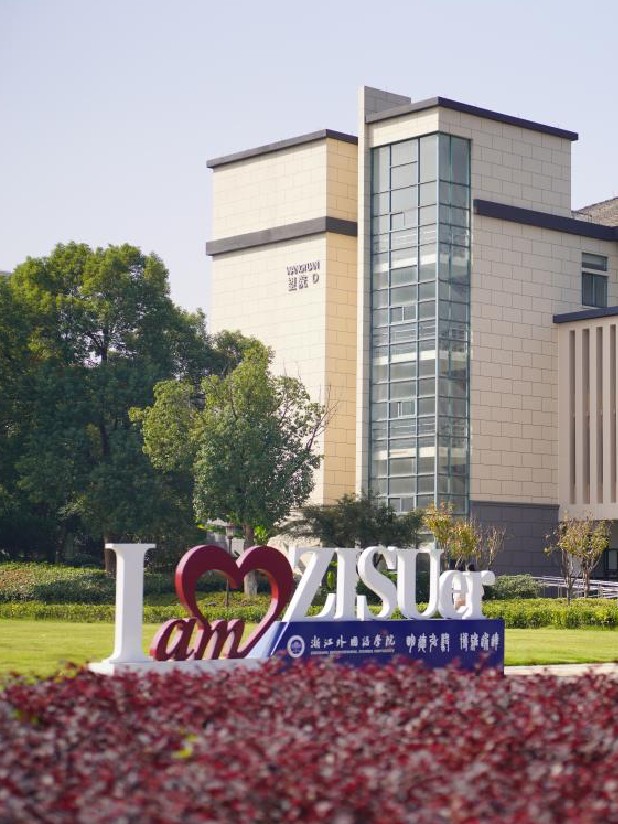
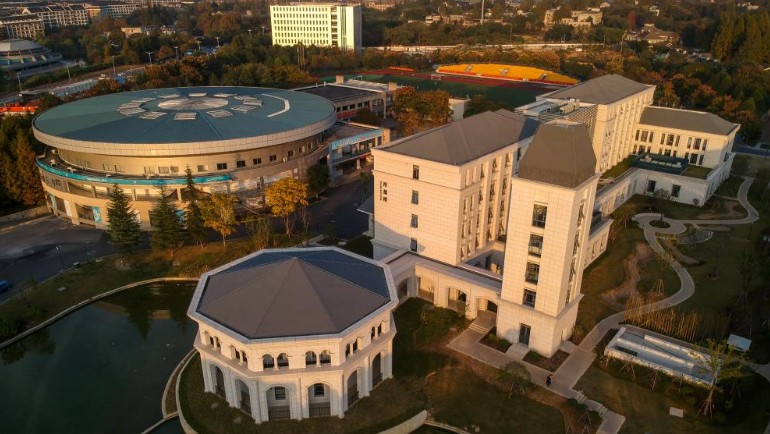
ZISU is located in the Xiaoheshan Higher Education Park, and adjacent to the Xixi National Wetland. Its campus is beautifully designed, with well-maintained and continually improving infrastructure. The university boasts fully equipped modern teaching facilities, including a number of key experimental teaching demonstration centers of the province. It houses a variety of advanced and specialized labs for language learning, simultaneous interpretation, international communication, teacher education, tourism management, e-commerce, and digital humanities. Its library is well-stocked with a rich collection of resources.
Prospect
In recent years, ZISU has closely aligned itself with national and provincial development priorities, focusing on high-quality development, strengthening its unique characteristics, and enhancing its core competitiveness. Following the new mission of building itself into an “internationally prestigious foreign studies university distinguished by its contribution to the development of new international relations”, the school aims to optimize and upgrade its key disciplines and programs, and transform itself into a major base for cultivating international talents, a strategic think tank supporting Zhejiang’s openness, and an important platform for international cultural and educational exchanges in Zhejiang, making its due contribution to the building of a community with a shared future for mankind.
With the collaborative initiatives of Zhejiang province with Peking University to support ZISU’s development, the school is striving to further enhance its capabilities, thus making greater contribution to Zhejiang’s efforts of creating an important window for achieving socialist common prosperity and provincial-level modernization.
(Data as of September 2025)